

I have a curiously odd computer problem: my motherboard will not power down. I have stripped my system down to just the power supply, motherboard, and chip. The system will not turn off! If the power cord is in and the switch on the back of the computer is in the ON position, the computer stays in some weird, vegetative, on-like state. It is non-responsive, and has no video output - it's in some kind of computer-coma.
So, the culprit could be:
1. Power supply is screwed
2. Motherboard is screwed
3. Intel chip is screwed
Or, perhaps, it is a combination of those three. Or maybe aliens are screwing with me. As exciting as that option might be, I doubt it.
By the way, those three options are in my order of 'preference'. Power supplies are cheap; the motherboard isn't cheap but it's still not a killer; the same P4 chip, however, runs a couple hundred bucks. Ugh.
I hate it when technology fails.
Thank God the iBook is my main computer.
*knocks on wood*
Saturday, June 24, 2006

Sunday, June 11, 2006
Natural Selection and Mating
Imagine if you will two Dingdongs: Dingdong A and Dingdong B. What species of animal a Dingdong is is irrelevant (mostly because I just pulled it out of thin air). Dingdong A and Dingdong B are completely identical in all ways except for one: Dingdong A is feisty when it comes to partnering and mating, whereas Dingdong B is indifferent. Both Dingdong A and Dingdong B have the same machinery for producing offspring; however, Dingdong A has a drive to find a mate, while Dingdong B will do it only if the opportunity arises.
Assume that the children of both Dingdong A and Dingdong B have an equal probability of growing to sexual maturity - who do you think will produce more children?
I would venture to say Dingdong A. Dingdong A will "beat out Dingdong B to potential mates. So while Dingdong B sits around and takes a mate when he/she can, Dingdong A is out and about actively seeking a mate.
So now let's say that we start with a population of 50% Dingdong A and 50% Dingdong B. What will happen to this population? Over generations, it will slowly shift to become Dingdong A heavy and Dingdong B light. Who knows, maybe Dingdong B will disappear. It isn't that Nature "desired" one over the other, or one was intrinsically better than the other. Random chance has given us two characteristics: feisty and non-feisty. Over time, one characteristic is better able at producing descendants than another. More descendants, more evolutionary success, more of your genes out in the gene pool.
This hypothetical example shows that an animal with a drive to attain a mate is going to be selected for over against an animal without a drive to attain a mate.
What's the point?
Well, twofold. First, it shows how evolution could work in simple, observable terms. Second, it shows a possible reason why we humans actually desire a partner and a mate. It just may be a parting gift from one of our ancestors.
Assume that the children of both Dingdong A and Dingdong B have an equal probability of growing to sexual maturity - who do you think will produce more children?
I would venture to say Dingdong A. Dingdong A will "beat out Dingdong B to potential mates. So while Dingdong B sits around and takes a mate when he/she can, Dingdong A is out and about actively seeking a mate.
So now let's say that we start with a population of 50% Dingdong A and 50% Dingdong B. What will happen to this population? Over generations, it will slowly shift to become Dingdong A heavy and Dingdong B light. Who knows, maybe Dingdong B will disappear. It isn't that Nature "desired" one over the other, or one was intrinsically better than the other. Random chance has given us two characteristics: feisty and non-feisty. Over time, one characteristic is better able at producing descendants than another. More descendants, more evolutionary success, more of your genes out in the gene pool.
This hypothetical example shows that an animal with a drive to attain a mate is going to be selected for over against an animal without a drive to attain a mate.
What's the point?
Well, twofold. First, it shows how evolution could work in simple, observable terms. Second, it shows a possible reason why we humans actually desire a partner and a mate. It just may be a parting gift from one of our ancestors.
Wednesday, June 07, 2006
Statistics show that Kevin is crazy
There is something very wrong with me. Something very, horribly, wrong. I cannot understand it. I don't even think I know who I am anymore.
I actually like statistics.
What is wrong with me?!?
I have tried to figure out why I'm actually enjoying learning about statistical tests - goodness of fit, normal, ANOVA. Oh me oh my!
Perhaps it's because statistics is in large part trying to understand the unknown. How to go from what we do know, and applying it to what we don't know - going from sample to population. I might just be so pissed off at not 'knowing' anything that probabilistic-knowledge seems pretty appealing to me. All my learning has driven out certainty and truth. What is certain? What is true? What is true in the realm of religion, or ethics? Who can answer such questions? But with statistics, we can come to some probabilistic answer: it seems like this is the case - 5% chance we're wrong. I must admit, that's not too shabby.
Or maybe it's because for once I really look forward to using what I learn in one class (statistics) in another class (animal physiology lab). I haven't had such direct applicability for a long time. It is refreshing, to say the least.
I may never know why I like statistics. I have a feeling it's just a phase, like so many other intellectual phases that have come and gone.
It will all be over in a week, no doubt.
I actually like statistics.
What is wrong with me?!?
I have tried to figure out why I'm actually enjoying learning about statistical tests - goodness of fit, normal, ANOVA. Oh me oh my!
Perhaps it's because statistics is in large part trying to understand the unknown. How to go from what we do know, and applying it to what we don't know - going from sample to population. I might just be so pissed off at not 'knowing' anything that probabilistic-knowledge seems pretty appealing to me. All my learning has driven out certainty and truth. What is certain? What is true? What is true in the realm of religion, or ethics? Who can answer such questions? But with statistics, we can come to some probabilistic answer: it seems like this is the case - 5% chance we're wrong. I must admit, that's not too shabby.
Or maybe it's because for once I really look forward to using what I learn in one class (statistics) in another class (animal physiology lab). I haven't had such direct applicability for a long time. It is refreshing, to say the least.
I may never know why I like statistics. I have a feeling it's just a phase, like so many other intellectual phases that have come and gone.
It will all be over in a week, no doubt.
Monday, May 22, 2006
The Paradigm of the Cross of Jesus
Evil, hatred, anger, malice - all these things require people to propagate them. When someone hurts you, attacks you, you have two choices. First, you can lash back. You can continue the chain--whether it is a closed loop of two people, or an open chain of a whole nation--by returning hatred, anger, and harshness upon another. The second choice is to stop it. You can stop the chain dead in it's tracks.
You must take the momentum of the hatred, of the anger, and absorb it upon yourself. It is an odd metaphor, I know, but it is true. You have to take it upon yourself to let all the momentum land upon you, and choose not to reflect it onto another person.
This is how I see the paradigm of the Cross of Jesus: he let evil stop at him. He didn't retort, he didn't strike back, he didn't organize a rebellion. He let it stop at him. He gave us a paradigm, an example of how to live righteously. An example of how to stop hate, and hurt, and pain. It is a paradigm for those who follow in the way of Jesus, who seek to live in the wisdom that this teacher gave us in his life and teachings.
Maybe it's the whole 'turn the other cheek' bit?
I don't know. But I do know that it is a nugget of pure gold - a godsend of wisdom upon my life. When I try to win, or try to get the upper hand, everything fucks up. When I stop trying to win, and stop the heated momentum, everything calms down.
Curiously, I see this paradigm elsewhere:
In the Matrix movies, Neo tries to fight Agent Smith over and over again. It never works, Smith only keeps getting stronger and stronger (as does Neo). But when Neo finally allows Smith to 'kill' him, only then does he finally attain victory over Smith. He absorbs it upon himself, stops it in its tracks, and is truly victorious.
I close with a U2 Lyric:
You don't have to put up a fight,
You don't have to always be right,
Let me take some of the punches
for you tonight.
(Sometimes You Can't Make It On Your Own)
You must take the momentum of the hatred, of the anger, and absorb it upon yourself. It is an odd metaphor, I know, but it is true. You have to take it upon yourself to let all the momentum land upon you, and choose not to reflect it onto another person.
This is how I see the paradigm of the Cross of Jesus: he let evil stop at him. He didn't retort, he didn't strike back, he didn't organize a rebellion. He let it stop at him. He gave us a paradigm, an example of how to live righteously. An example of how to stop hate, and hurt, and pain. It is a paradigm for those who follow in the way of Jesus, who seek to live in the wisdom that this teacher gave us in his life and teachings.
Maybe it's the whole 'turn the other cheek' bit?
I don't know. But I do know that it is a nugget of pure gold - a godsend of wisdom upon my life. When I try to win, or try to get the upper hand, everything fucks up. When I stop trying to win, and stop the heated momentum, everything calms down.
Curiously, I see this paradigm elsewhere:
In the Matrix movies, Neo tries to fight Agent Smith over and over again. It never works, Smith only keeps getting stronger and stronger (as does Neo). But when Neo finally allows Smith to 'kill' him, only then does he finally attain victory over Smith. He absorbs it upon himself, stops it in its tracks, and is truly victorious.
I close with a U2 Lyric:
You don't have to put up a fight,
You don't have to always be right,
Let me take some of the punches
for you tonight.
(Sometimes You Can't Make It On Your Own)
Friday, May 05, 2006
Random Stream of Consciousness
My one week of relaxation is over. Summer session begins on Monday. I have 23 hrs of school a week (17hrs of lecture, 6 hrs of lab). It lasts for 8 weeks. I'm going to be very, very glad when it's over.
All my marks are out, finally. I will only say this - wow! It's a sad day when the highest mark you ever get in university is from Physical Chemistry. It's even more sad when it's from the course I never attended and thought would definitely fail. Oh well. University is weird like that.
I've managed to finish another game of Civ IV. Nothing spectacular, I'm just an amateur. Noble domination win, large balanced map, a good 7 or 8 civs. I think I just beat out Hatty's spaceship. Very close call.
I'm very relieved. My marks now are pretty much set for med-school applications. Some schools are gonna include my summer courses from this semester, some aren't. But 10 credits aren't gonna change very much. And I hope to do well...semi-well...maybe?
I really like this rollerhockey league. Though we've gotten our arse handed to us lately, it's fun to get out and play some hockey with a few friends. Good sport, good exercise. Although, I have a feeling we'd have a much better time if we went down a tier or two. That will be decided after our game this Sunday.
* * * *
All my marks are out, finally. I will only say this - wow! It's a sad day when the highest mark you ever get in university is from Physical Chemistry. It's even more sad when it's from the course I never attended and thought would definitely fail. Oh well. University is weird like that.
* * * *
I am officially addicted to 24. This tension is killing me. Aie ya! So many hours left, I wonder oh I wonder!
Oh, and I'm interested in CSI now.
Either way. I will only go DVD seasons. I can't stand television: I want uninterrupted, commercial-free, entertainment when I want it.
Oh, and I'm interested in CSI now.
Either way. I will only go DVD seasons. I can't stand television: I want uninterrupted, commercial-free, entertainment when I want it.
* * * *
I've managed to finish another game of Civ IV. Nothing spectacular, I'm just an amateur. Noble domination win, large balanced map, a good 7 or 8 civs. I think I just beat out Hatty's spaceship. Very close call.
* * * *
I'm very relieved. My marks now are pretty much set for med-school applications. Some schools are gonna include my summer courses from this semester, some aren't. But 10 credits aren't gonna change very much. And I hope to do well...semi-well...maybe?
* * * *
I really like this rollerhockey league. Though we've gotten our arse handed to us lately, it's fun to get out and play some hockey with a few friends. Good sport, good exercise. Although, I have a feeling we'd have a much better time if we went down a tier or two. That will be decided after our game this Sunday.
The eel in the cave
For all you doubters, here are some screen caps with subtitles. I told you, she was talking about her 'cave'.
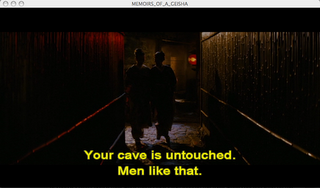
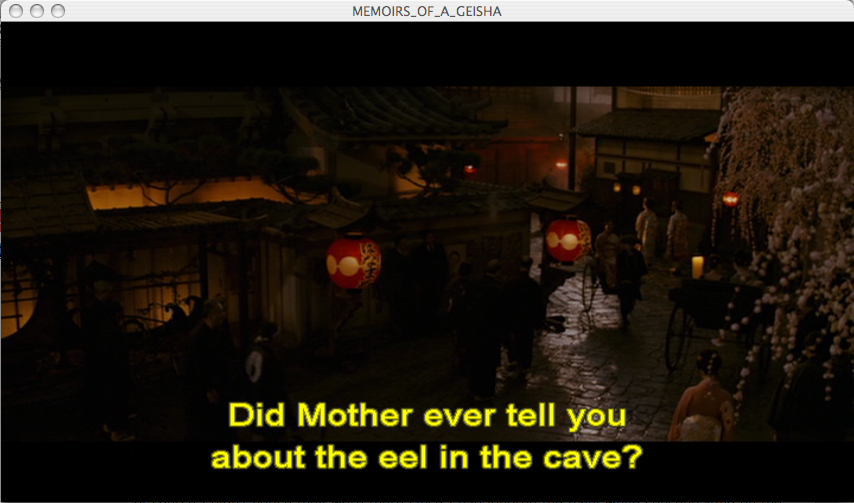
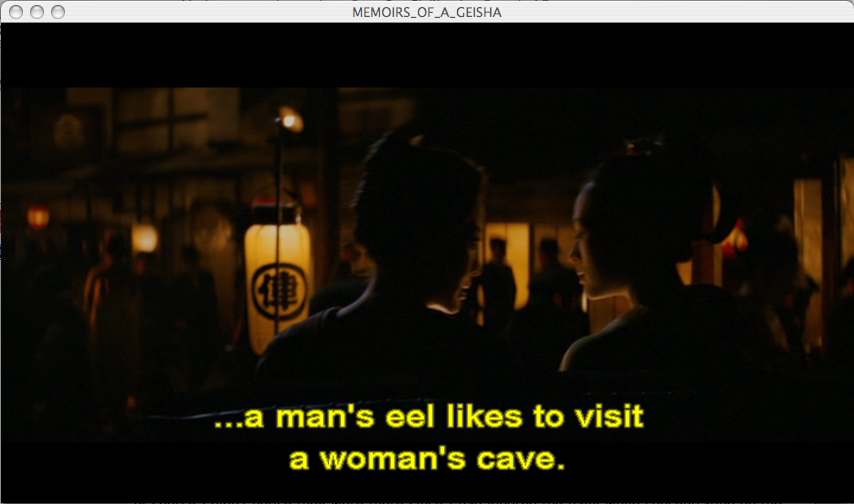
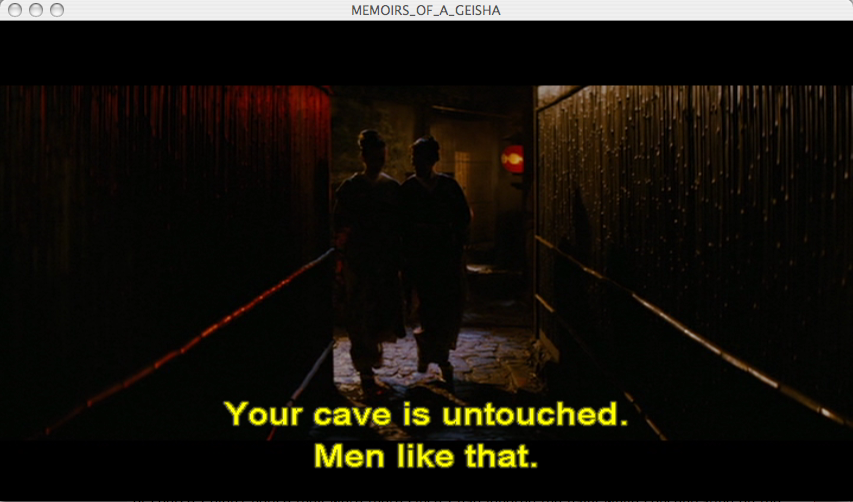
Trust me, my friends, I didn't grow up watching movies on subtitles - I actually listen.
Sunday, April 23, 2006
Inerrancy, so what? A career revolution
I think many of you are wondering why I've thought so long and so hard about biblical inerrancy. For many, this seems like a useless case of intellectual gymnastics, having little relevance to daily life. I'm afraid that isn't so. I think that my views of the inerrancy of the Bible have had a very direct impact on my life.
During my first and second years of university, I was aiming to go into graduate studies in Christianity and become a New Testament scholar. I had always thought that my scholarship could be of service to the Church; my little bit in helping the whole 'body' move along. "The Bible is sacred text, the word of God, so we need to understand it as best we can and live by it." Or so I thought.
Soon, I came to realize that I just can't believe in biblical inerrancy. With this, came a depreciation of the value of the Bible in my life. It was no longer the very words of God, like the Christian version of the Holy Qur'an. Now it just a mish-mash of religious literature written by Jews and Christians over about a thousand year period. It became to me, in every way possible, a human text.
As this happened, I became less and less motivated to study the Bible. Now don't get me wrong, I still love the Bible, and I think it is one of the most important books ever. Personally, the Bible plays a big role in my life and in my interests. However, it no longer was about "scholarship for the Church". Losing my belief in the inerrancy of the Bible was intertwined with the rise of critical attitude in me. No longer was the Bible off limits for me - "question everything", I said.
Could I really spend the rest of my life--my whole career--studying a collection of texts, supposedly authoritative for my faith, when I no longer saw much authority or certainty in them? My faith was shaky, I didn't even know if I was still going to be a Christian in 10 years. Could I still devote the rest of my life, with considerable financial and emotional hardship, to studying texts of Christian faith. No. I couldn't.
Then I found that several things started to change. All along during my undergraduate studies, I had been pursuing concurrent studies in Religious Studies and Biology. The Religious Studies was because of my initial desire to become a New Testament scholar. The Biology was--VERY long story short--because of background interest and family wisdom. (Family wisdom turned out to be so, SO true). For several years, I wasn't very interested in the Biology side of my degree. I invested a lot more time in my Religious Studies. After all, it was my first career choice. But then with my transition away from biblical inerrancy, away from a certain and strong faith, I found myself gravitating more and more towards Biology.
I began to live a simplified message of Christianity: love God and love your neighbour. Helping people in definite and concrete ways seemed much more valuable in life than throwing around ideas in towers made of ivory.
It was at this point that a career in medicine seemed to make so much sense. My reconstructed Christian faith placed much more value in helping people in their lives than trying to "save them for eternity". I was starting to regain interest in Biology. I could definitely see myself as a physician. I realized just how rewarding such a career would be. I talked to people, I did research, I did lots of thinking. I would really love to be a doctor.
In fact, this is nothing new. I once memorized some 30 major bones in the body - on a family vacation. In elementary school. Also, my goal in initially going into Engineering out of high school was to go into biomedical engineering - I really wanted to make prosthetics and devices to help injured and sick people. But the year or two that I was all wrapped up in Religious Studies had turned me aside from what was a lifelong passion. But it was back.
Giving up biblical inerrancy, and the certainty in faith that came along with it, led to a complete change in career aim: from New Testament scholar to physician.
I hope you all now see why inerrancy is such a big deal to me. It has truly changed my life.
During my first and second years of university, I was aiming to go into graduate studies in Christianity and become a New Testament scholar. I had always thought that my scholarship could be of service to the Church; my little bit in helping the whole 'body' move along. "The Bible is sacred text, the word of God, so we need to understand it as best we can and live by it." Or so I thought.
Soon, I came to realize that I just can't believe in biblical inerrancy. With this, came a depreciation of the value of the Bible in my life. It was no longer the very words of God, like the Christian version of the Holy Qur'an. Now it just a mish-mash of religious literature written by Jews and Christians over about a thousand year period. It became to me, in every way possible, a human text.
As this happened, I became less and less motivated to study the Bible. Now don't get me wrong, I still love the Bible, and I think it is one of the most important books ever. Personally, the Bible plays a big role in my life and in my interests. However, it no longer was about "scholarship for the Church". Losing my belief in the inerrancy of the Bible was intertwined with the rise of critical attitude in me. No longer was the Bible off limits for me - "question everything", I said.
Could I really spend the rest of my life--my whole career--studying a collection of texts, supposedly authoritative for my faith, when I no longer saw much authority or certainty in them? My faith was shaky, I didn't even know if I was still going to be a Christian in 10 years. Could I still devote the rest of my life, with considerable financial and emotional hardship, to studying texts of Christian faith. No. I couldn't.
Then I found that several things started to change. All along during my undergraduate studies, I had been pursuing concurrent studies in Religious Studies and Biology. The Religious Studies was because of my initial desire to become a New Testament scholar. The Biology was--VERY long story short--because of background interest and family wisdom. (Family wisdom turned out to be so, SO true). For several years, I wasn't very interested in the Biology side of my degree. I invested a lot more time in my Religious Studies. After all, it was my first career choice. But then with my transition away from biblical inerrancy, away from a certain and strong faith, I found myself gravitating more and more towards Biology.
I began to live a simplified message of Christianity: love God and love your neighbour. Helping people in definite and concrete ways seemed much more valuable in life than throwing around ideas in towers made of ivory.
It was at this point that a career in medicine seemed to make so much sense. My reconstructed Christian faith placed much more value in helping people in their lives than trying to "save them for eternity". I was starting to regain interest in Biology. I could definitely see myself as a physician. I realized just how rewarding such a career would be. I talked to people, I did research, I did lots of thinking. I would really love to be a doctor.
In fact, this is nothing new. I once memorized some 30 major bones in the body - on a family vacation. In elementary school. Also, my goal in initially going into Engineering out of high school was to go into biomedical engineering - I really wanted to make prosthetics and devices to help injured and sick people. But the year or two that I was all wrapped up in Religious Studies had turned me aside from what was a lifelong passion. But it was back.
Giving up biblical inerrancy, and the certainty in faith that came along with it, led to a complete change in career aim: from New Testament scholar to physician.
I hope you all now see why inerrancy is such a big deal to me. It has truly changed my life.
Subscribe to:
Posts (Atom)